Dressed in the Height of Roman Fashion
A Clockwork Orange and the uniform of violence
Cinema of the Void · draft v0.1 · 2026-11-07
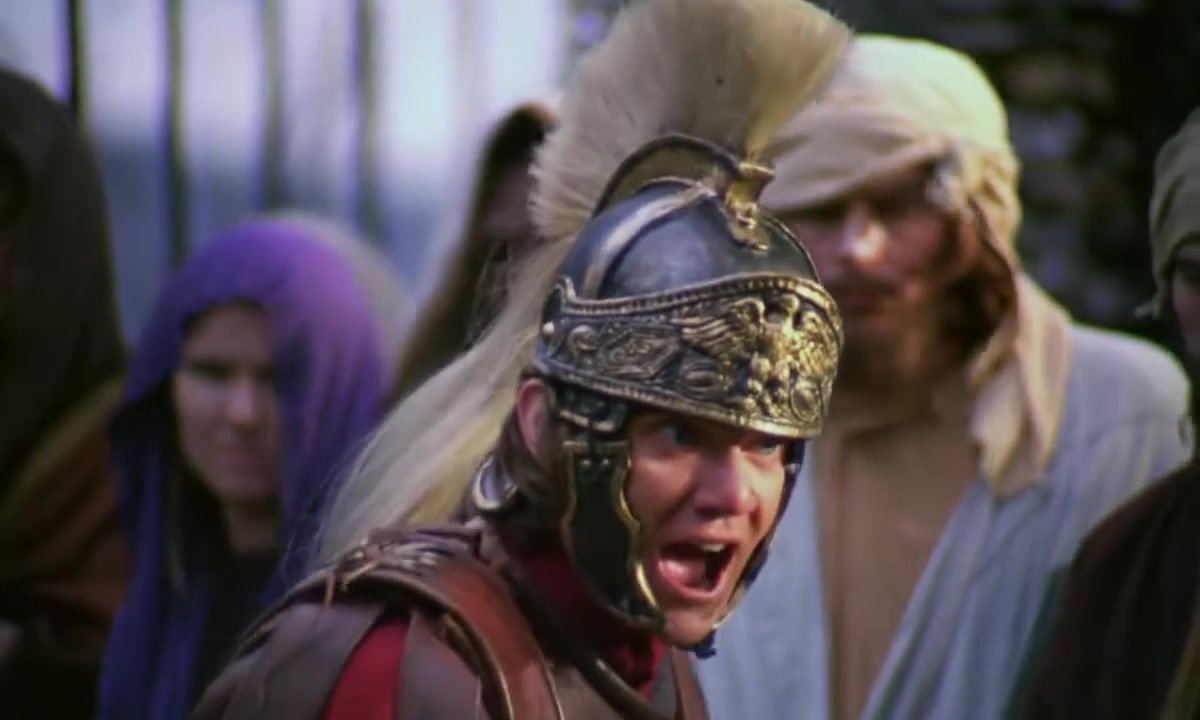
Halfway through A Clockwork Orange, Alex sits in the prison library with the Bible open, and he is happy. He has found the good parts. He skips the sermons and goes straight to the scourging, and in his head he is there on the road to Golgotha with a whip in his hand, "dressed in the height of Roman fashion." Kubrick cuts to it: Alex in a centurion's tunic, laying into Christ, grinning into the lens.
Everybody remembers the joke. The delinquent reads the holy book and roots for the soldiers. But look at what the fantasy actually is. Of every role in scripture, Alex picks the cop. The Romans were the occupying authority, the legal order, the guards. The id, given the whole of scripture to play in, picks the uniform.
That one image holds the whole film, and it answers the question underneath it. What is the difference between the violence of Alex and the violence of the men who cage him? Kubrick's answer, shot after shot, is a costume.
The lens belongs to whoever is swinging

Kubrick tells you this with the camera before any character says a word about it.
When the droogs invade the writer's house, Kubrick drops an extreme wide-angle lens to floor level: Dim's clown-nosed face swells toward us while Alex goes to work on Mrs. Alexander behind him, the room bending away. When Mr. Deltoid, the "post-corrective adviser," comes to gloat over Alex at the police station, bloodied boy at the edge of frame and the cops crowding behind, he gets the exact same lens: the same bloat, the same lunge into the frame. When Mr. Alexander, the liberal victim, finally gets his revenge, his screaming face fills the frame in the same distortion. Gang, state, victim: one optical signature. The lens belongs to whoever is doing the hurting.
The same goes for the way people walk. The droogs move along the embankment in a loose line, Alex in front, canes swinging. Later the prisoners shuffle in a circle around the prison yard under a white sky. Later still, Dim and Billy Boy, the old gang, now wearing police uniforms, march Alex out into the countryside and hold his head under water in a trough. It is the same formation each time, with the same leader-and-flank geometry. Only the clothes change.
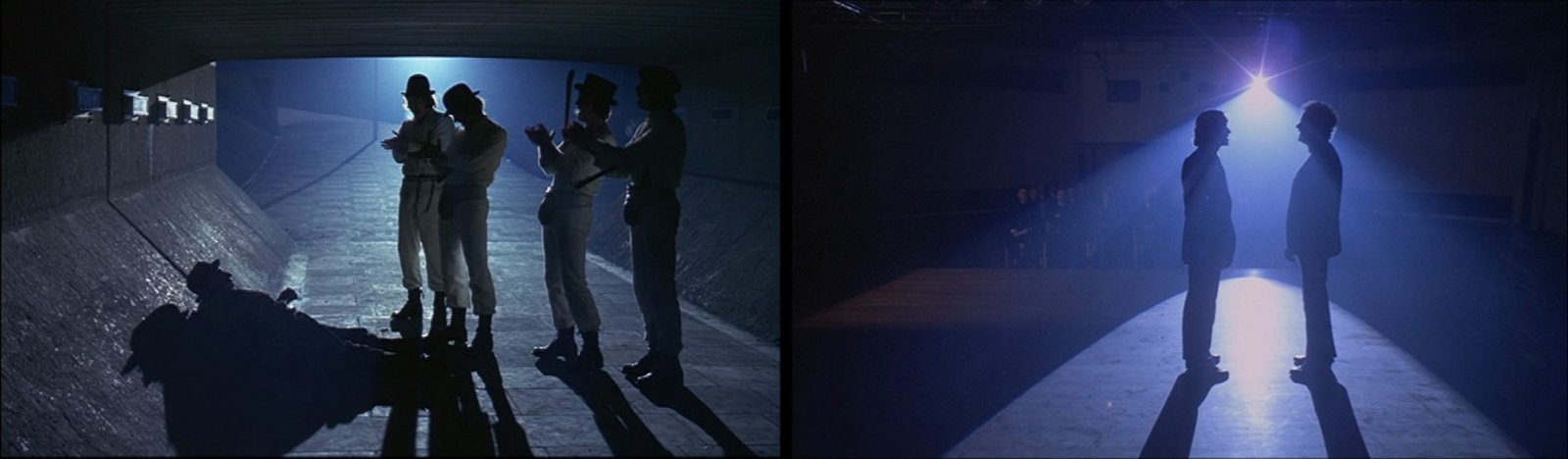
And the light. The droogs beat the old drunk in a concrete underpass, four silhouettes cut out of a single hard backlight. After the Ludovico treatment, the state puts Alex on an actual stage in front of an audience of officials and makes him lick the shoe of a man who is beating him. Kubrick lights it the same way: two silhouettes, one hard source, a black void around them. The tunnel and the theater are the same picture. The difference is that the second one has an audience in suits and the audience applauds.
The old men's hands

You noticed it and you are right to: authority in this film is erotic, and its eros is all hands.
Mr. Deltoid sits on Alex's bed and grabs his crotch while lecturing him about his future. The chief guard, barking procedure like a drill sergeant, has Alex strip and bend, and inspects him with a flashlight. The prison chaplain rests a soft hand on Alex's shoulder among the bookshelves. At the end, the Minister of the Interior sits at the hospital bed and feeds Alex steak, forkful by forkful, while the press photographers jam the doorway.
Alex's sexuality is out in the open, monstrous and loud: the rape, the phallic sculpture used as a club, the sped-up orgy. Theirs is routed through procedure. They take the boy by processing him. They search him, counsel him, condition him, feed him. It is the eros of men who have power and no potency, and violence is the only touch the institution allows them.
Freud has the mechanism for this, and it is darker than the usual id-ego-superego diagram. In Civilization and Its Discontents he argues that the severity of the superego is borrowed. Civilization takes the aggression it forbids, turns it back inward, and hands it to the conscience to use. The superego is cruel because it is built out of the same energy as the id. It has only changed address. Alex is the id. The chief guard, the chaplain, Deltoid, the Minister are the superego. And the film shows you, frame for frame, that they are made of the same material.
The lodger's glee
Then there is Joe.
Alex comes home from the clinic, cured, and finds a lodger in his room, wearing his clothes and eating at his table. Joe stands up to deliver a little sermon: Alex has made others suffer, so it is only right that he suffer properly. He says Alex makes him sick. And he is enjoying himself. You can see it. This is the best moment of Joe's life.
Joe is the most frightening character in the film because he is the most ordinary. He has no badge, no collar, no ministry. All he has is a moral position, and a moral position turns out to be a license. It lets him enjoy another person's punishment with a clean conscience. His glee and Alex's glee are the same glee. Alex calls it a bit of the old ultraviolence. Joe calls it justice.
Rome, the Reich, and the local weather of law

The Romans in Alex's daydream were right, by the law of their day. Crucifixion was standard procedure. It took centuries for that verdict to flip. Legality is local weather.
Kubrick makes this explicit in the Ludovico sessions. Strapped into the chair, eyelids clamped open, eye drops dripping from a tiny pipette, Alex is shown footage of the Third Reich: marching columns, the eagle, the bombing, scored to Beethoven's Ninth. And Alex's protest is aesthetic. He objects that they are using Ludwig van like that. He has no complaint about the Nazis. The film shows a whole society in which violence is the normal way of the land, and the one person who objects to it does so on behalf of the music.
That is the condition every character in this film lives in. Violence is the medium. Alex, the droogs-turned-cops, the guards, the doctors, the writer with his torture-by-Beethoven in the attic, the Minister with his photo op: each of them is fluent in it. What separates them is who signs off.
One point, one truth

When I wrote about 2001, I argued that one-point perspective is a picture of a universe with a single truth: every line converging on a single vanishing point, a single correct place to stand. Kubrick builds the same machine here and hands it to the state.
The prison corridor is pure one-point, receding to a single door. The Ludovico clinic's lobby is symmetrical and empty with one axis. The Brutalist campus Alex walks into is a set of concrete planes lined up on a center. Institutions in this film own the vanishing point. They claim the single correct place to stand, and they claim it as geometry.
The institutions also own stillness. Measured shot by shot, the authority scenes barely move. Deltoid's visit to Alex's bedroom plays in a single take of almost two minutes. The prison check-in, the chief guard barking out Alex's property at the records desk, holds on one locked-off frame for nearly two minutes. The interrogation and the Minister's tour of the prison are fully static too. The camera sits there like a surveillance lens, letting the procedure run. When Alex is free, at the Flatblock Marina or in the street, the camera starts to move again.
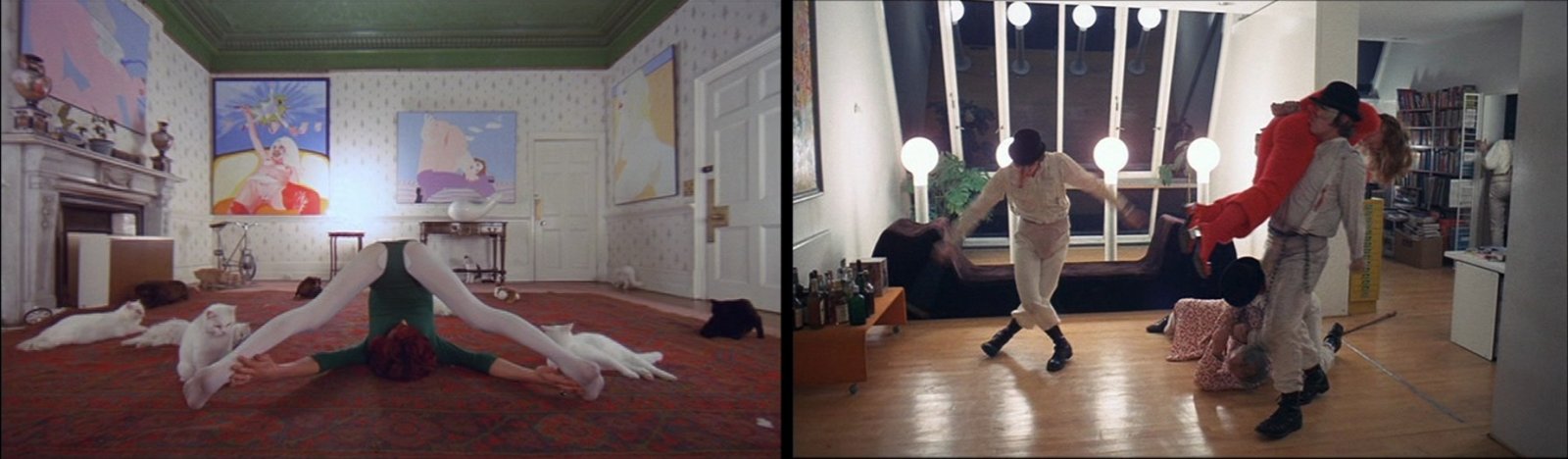
Alex's world runs the other way: the fun-house wide angles of the writer's house and the Cat Lady's health farm, the pop-art bedroom, the Korova milk bar with its white mannequin tables, everything canted and bulging and close. The id lives in curved space. The superego lives in a corridor. Both of them are distortions. Neither of them is the truth. They are two lenses.
So where is the real morality?
One person in the film says it out loud, and it is the chaplain, the soft-handed one, standing in front of the crucifix in a prison chapel. Before the treatment, he warns Alex that goodness is something chosen, that when a man cannot choose, he ceases to be a man. After the treatment, when the Minister shows off his reformed boy on the stage, the chaplain objects again: the boy has no real choice; he has stopped being a wrongdoer, and he has also stopped being a creature capable of moral choice. The Minister waves it off. We are not concerned with motives, he says, or with the higher ethics. We are concerned with cutting down crime.
That exchange is the closest thing the film offers to an absolute. Burgess put it at the center of the novel. The Romans had a list of approved acts. So did the Reich. So does Joe. Morality, if it exists, is a structure: the capacity to choose. The state's crime and Alex's crime turn out to be the same crime: each one takes away the choice of another body.
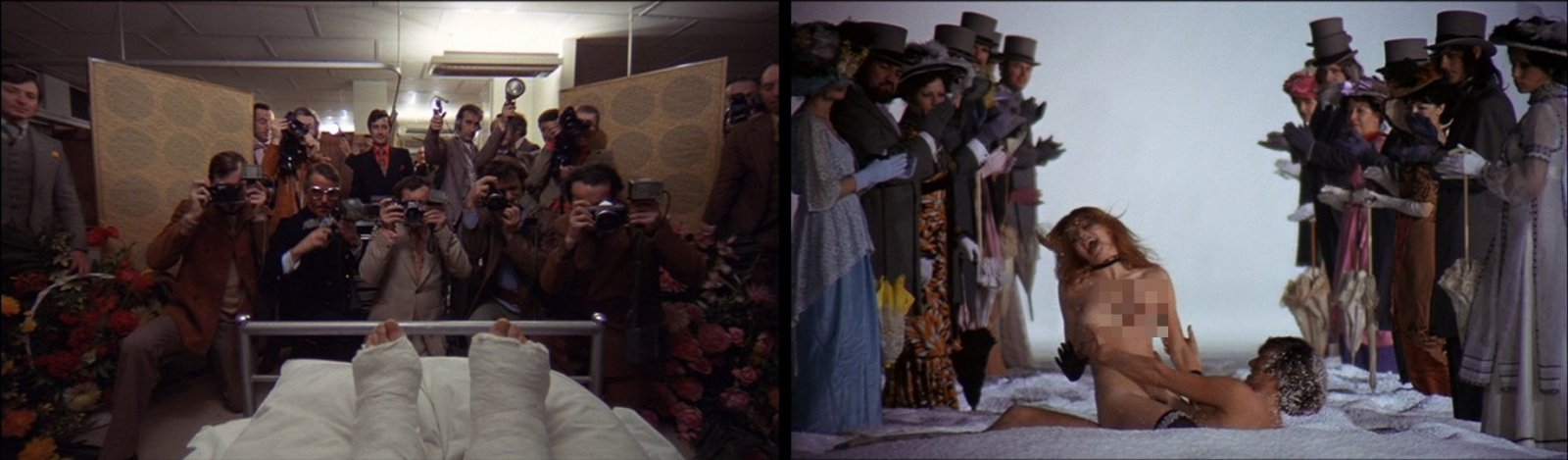
And still the film refuses to let that answer be clean. The chaplain who says it is part of the machine. He keeps his post and preaches from inside the prison. His protest changes nothing. And Kubrick worked from the American edition, which dropped Burgess's final chapter, the one where Alex grows up, gets bored of violence, and chooses to stop. Kubrick ends a chapter earlier, on Alex in the hospital bed, flashbulbs going off, the Minister's arm around him, Beethoven swelling, and Alex imagining himself rolling in the snow with a woman while a crowd of ladies and gentlemen in period dress and top hats applauds politely. "I was cured, all right."
The cure is a job offer. The state hires the id. The droogs became cops. The Roman fashion was always on offer. The final image is society applauding the id, now that the id has signed on.
The chair is ours

The most uncomfortable thing in the film is the movie theater inside it. The Ludovico technique is cinema. A young man is strapped into a seat in a dark room with his eyes held open and made to watch images until his body learns what to feel. The doctors sit behind him at the console, watching him watch.
And we are in the seat too. We sang along to "Singin' in the Rain." We enjoyed the speed-up orgy and the choreography of the fights. Kubrick conditioned us with pleasure the way Brodsky conditioned Alex with nausea, and then showed us the apparatus.
This is where A Clockwork Orange becomes a description of now. We are building machines that can generate infinite images, tuned by feedback to produce exactly the feeling that keeps the eye open. The feed is a Ludovico chair with no straps. Nobody needs to clamp the eyelids anymore.
If the film has a morality, it lives in that gap: the moment before the next image, where you still get to choose what you look at, and what you make. In that gap the eyelids are ours. So is the camera.